
The Submerged State: Southern Brazil’s Endless Battle with Water
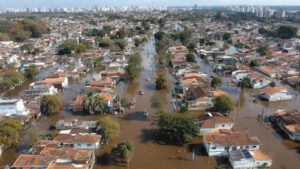
The images coming out of Rio Grande do Sul this week are hauntingly familiar, yet unprecedented in their scale. For the third time in as many years, the state’s complex river systems have burst their banks, inundating hundreds of municipalities and forcing the state capital, Porto Alegre, into a standstill.
While the “Great Flood” of 2024 was thought to be a once-in-a-century event, the May 2026 deluge has proven that the climate floor has shifted. With rainfall totals tripling monthly averages in just 48 hours, the infrastructure designed to protect millions is once again failing, leading to a humanitarian emergency that is redrawing the map of southern Brazil.
The Human Toll: Beyond the Numbers
As of this morning, civil defense agencies have confirmed a rising death toll, with dozens still missing in the interior highlands where landslides have swept away entire hillside communities.
However, the most significant statistic of 2026 isn’t just the fatalities—it’s the displaced. Experts are identifying this as a landmark “climate-migration” event. Unlike previous years where residents waited for the waters to recede to rebuild, thousands are now abandoning their homes permanently. Entire neighborhoods in the Guaíba archipelago are being designated as “unrecoverable,” sparking a mass exodus of internal refugees seeking higher ground in the country’s north or in neighboring Uruguay.
The Economic Aftershock: Rice and Resilience
The timing of the floods has dealt a devastating blow to Brazil’s “breadbasket.” Rio Grande do Sul is responsible for roughly 70% of Brazil’s rice production.
The 2026 floods hit at the tail end of the harvest season, submerging silos and destroying logistical corridors. Market analysts warn that global rice prices could see a sharp uptick as Brazil—traditionally an exporter—may be forced to import grain to meet domestic demand. To combat this, the federal government has activated the “Rio Grande Plan,” a R$ 14 billion restructuring fund aimed at moving agricultural processing hubs away from flood-prone river basins.
“Psychic Disorganization”: The Invisible Crisis
Psychologists on the ground describe a state of “psychic disorganization” among the survivors. For many, this is the third time they have lost everything since 2023. This cumulative trauma is driving the migration trend; the psychological cost of living in a “high-risk” zone has finally outweighed the cultural and historical ties many families have to the land.
“We are no longer talking about disaster relief; we are talking about managed retreat,” says Dr. Elena Moraes, a climate researcher. “Rio Grande do Sul is the frontline of a global shift where the land simply refuses to be lived on anymore.”
The Road Ahead: Building for a New Reality
Governor Eduardo Leite has called for a radical “re-engineering” of the state. The 2026 recovery strategy focuses on:
Elevated Infrastructure: Building “flood-resilient” schools and hospitals on high-altitude plateaus.
River Management: Intensive dredging and the construction of new polders to redirect excess water away from urban centers.
Migration Support: Providing financial pathways for families to relocate from “Permanent Preservation Areas” that are no longer safe for habitation.
Conclusion
The 2026 floods in Rio Grande do Sul are a sobering reminder that climate change is not a future threat, but a present-day reality for South America. As the waters slowly begin to recede, the state faces a choice: rebuild the past or design a different future. For the thousands currently sleeping in shelters, the dream of “going home” is being replaced by the necessity of moving on.
Brazil is now at the forefront of a global challenge—learning how to govern, house, and heal a population that is being physically pushed by the changing planet.