

AI Revolution 2026: The Global Race Reshaping Technology & Power
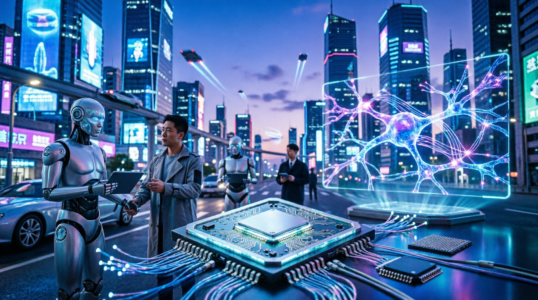 Artificial intelligence has become the most dominant technology story in the world, transforming industries, economies, and global competition at an unprecedented pace. From Silicon Valley to Beijing, governments and technology giants are racing to develop the next generation of AI systems capable of reshaping business, defense, healthcare, education, and everyday life.
Leading the AI race are companies like OpenAI, Google DeepMind, Microsoft, Meta, and NVIDIA. These firms are investing billions into advanced AI models, powerful chips, and autonomous systems that could define the future of global innovation.
The rapid rise of AI tools is already transforming workplaces worldwide. Businesses are increasingly using AI for customer service, data analysis, automation, marketing, software development, and creative content production. Experts believe AI-driven productivity could become one of the biggest economic shifts since the internet revolution.
At the center of this boom is the global AI chip race. NVIDIA has emerged as one of the world’s most valuable technology companies due to massive demand for AI processors. These chips power everything from chatbots and image generation to autonomous vehicles and scientific research. Countries are now treating semiconductors as strategic national assets, leading to growing geopolitical tensions surrounding technology exports and manufacturing.
Governments are also moving quickly to regulate artificial intelligence. Concerns around misinformation, cybersecurity, job disruption, and AI safety are pushing lawmakers to introduce new policies aimed at controlling how advanced AI systems are developed and deployed. International debates about “AI governance” have become increasingly urgent as technology evolves faster than regulation.
Another major trend is the rise of AI assistants and autonomous agents. Modern AI systems are becoming more capable of handling complex tasks, making decisions, and interacting naturally with humans. Tech leaders predict that AI agents could eventually manage workflows, businesses, research tasks, and digital ecosystems with minimal human intervention.
Meanwhile, competition between the United States and China is intensifying around AI leadership. Both nations see artificial intelligence as a critical factor in future economic and military dominance. This rivalry is accelerating investments in semiconductor manufacturing, cloud infrastructure, robotics, and advanced computing.
Despite the excitement, experts continue to warn about risks associated with rapid AI expansion. Ethical concerns around bias, privacy, deepfakes, and job displacement remain central to global discussions. At the same time, many industries are struggling to adapt to the speed of technological change.
Still, public fascination with AI continues to grow. Viral AI-generated videos, realistic digital assistants, and futuristic robotics demonstrations dominate social media daily. Investors, businesses, and governments increasingly view artificial intelligence not just as a tool—but as the foundation of the next technological era.
As innovation accelerates, the AI revolution is no longer a future concept. It is happening now, reshaping the global balance of power and redefining how humanity works, communicates, and creates.