Skip to content
AI Boom & AGI Race
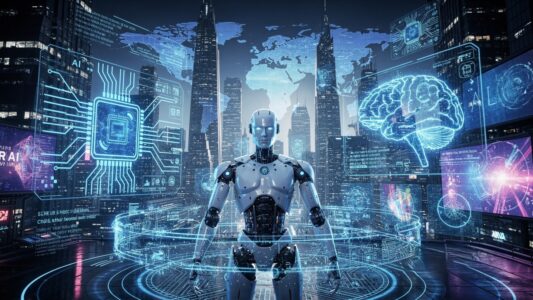 Artificial intelligence is no longer just a technological trend—it has become the defining global race of the decade. Across industries, governments, and financial markets, the competition to lead the future of AI is intensifying at unprecedented speed. Companies such as OpenAI, Google DeepMind, Microsoft, and Meta are aggressively investing billions into advanced AI systems, autonomous agents, and next-generation enterprise tools, fueling what many experts now call the “AI Boom.”
At the center of this race is the pursuit of Artificial General Intelligence (AGI)—AI systems capable of performing tasks with human-like adaptability and reasoning. While today’s AI models are already transforming industries, AGI represents a future where machines may handle complex decision-making, problem-solving, and creative tasks at levels previously thought impossible.
The rapid rise of AI assistants and autonomous digital agents is already reshaping workplaces worldwide. Businesses are integrating AI into customer service, data analysis, cybersecurity, marketing, software development, and financial operations. From automating repetitive tasks to enhancing productivity, AI is fundamentally changing how companies operate. Organizations that fail to adapt risk falling behind in an increasingly AI-driven economy.
Enterprise AI adoption has become one of the biggest growth areas in technology. Cloud computing giants are embedding AI into business infrastructure, while startups are launching specialized tools for healthcare, finance, logistics, and education. The combination of generative AI, automation, and real-time analytics is enabling companies to make faster decisions and reduce operational costs.
However, the AI revolution is also triggering intense global competition between nations. Governments worldwide are treating AI as a strategic asset tied to economic power, cybersecurity, and national security. The United States and China are leading the race, investing heavily in AI research, semiconductor manufacturing, and advanced computing infrastructure. Europe, India, and Middle Eastern economies are also increasing AI investments to remain competitive in the emerging digital economy.
This geopolitical competition has sparked debates around AI regulation and safety. Policymakers are grappling with concerns related to misinformation, deepfakes, cybersecurity threats, surveillance, and job displacement. International discussions are increasingly focused on establishing global AI governance frameworks to ensure responsible development while maintaining innovation.
The impact of AI on jobs remains one of the most widely discussed aspects of the current boom. While AI is expected to automate certain repetitive roles, it is also creating entirely new industries and career opportunities. Demand for AI engineers, prompt designers, data scientists, cybersecurity experts, and machine learning specialists is rapidly increasing. Experts believe the future workforce will require a blend of technical skills and human creativity to thrive alongside intelligent systems.
Financial markets are also heavily influenced by the AI race. Technology companies linked to AI infrastructure and chip production have experienced record growth, with investors betting that AI will become one of the largest economic drivers of the modern era. Semiconductor firms, cloud providers, and AI startups are attracting massive capital as businesses rush to secure competitive advantages.
Beyond economics, AI is influencing education, media, entertainment, and daily life. AI-powered tools are changing how students learn, how content is created, and how people interact with digital platforms. Social media feeds, recommendation systems, and virtual assistants are increasingly powered by advanced machine learning models capable of understanding user behavior in real time.
Despite the excitement, experts warn that the rapid pace of AI development comes with serious risks. Concerns over ethical use, bias, privacy, and the concentration of technological power remain unresolved. Some researchers argue that without proper safeguards, advanced AI systems could create significant societal disruptions in the future.
Still, the momentum behind AI continues to accelerate. Every major technology company is racing to release more advanced systems, while governments compete to secure leadership in what is becoming the world’s most important technological battleground.
In conclusion, the AI Boom and AGI race represent far more than a technology trend—they mark the beginning of a transformative era that could redefine economies, industries, and global power structures. As competition intensifies between corporations and nations alike, the outcome of this race may shape the future of humanity itself.