Skip to content
The Borderless Patient: How Stablecoins and Blockchain Rebuilt Medical Commerce
 In May 2026, the traditional boundaries of healthcare are dissolving. For a patient in London seeking specialized spinal surgery in India or a digital nomad in Bangkok requiring elective care, the “waiting game” of international finance is officially over.
The rise of Borderless Medical Commerce has replaced sluggish wire transfers and volatile currency exchanges with the precision of programmable finance. By leveraging fiat-backed stablecoins (digital assets pegged 1:1 to the US dollar or Euro), the medical tourism industry has unlocked a level of efficiency that was unimaginable just three years ago.
The Death of the 3-Day Wire Transfer
Historically, medical tourism faced a significant “friction” problem. High-cost surgeries often required large deposits, which were frequently delayed by intermediary banks and cross-border compliance checks. In 2026, this hurdle has been removed.
Using smart contracts, patients can now deposit funds into a digital escrow. These funds are only released to the hospital upon “verifiable triggers”—such as the patient’s arrival at the facility or the successful completion of a procedure. This “Trustless Transaction” model protects both the patient’s capital and the hospital’s revenue, ensuring that liquidity is instant and 24/7/365.
Programmable Finance Meets Patient Care
The innovation doesn’t stop at simple payments. The “programmable” nature of these 2026 financial tools allows for automated insurance reimbursements.
Leading international insurers are now using stablecoin-based tools to settle claims in near real-time. Instead of months of paperwork, the hospital’s billing system communicates directly with the insurer’s blockchain ledger. When treatment data matches coverage rules, the payment is triggered immediately. This slashes administrative overhead and allows hospitals to offer lower, more transparent pricing to international travelers.
Verifiable Credentials: The New Global Standard
As finance becomes borderless, so must the workforce. The 2026 trend has forced a critical conversation regarding Verifiable Credentials (VCs). In a decentralized, digital workforce where a patient might consult a specialist via telehealth in Brazil before flying to Mexico for surgery, how do you verify the doctor’s expertise?
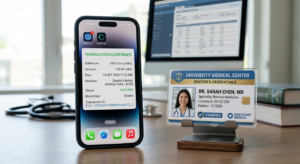
Enter the Decentralized Identifier (DID). Surgeons and clinicians in 2026 now carry tamper-proof digital files—standardized in formats like JSON-LD—that contain their medical degrees, board certifications, and surgical success rates.
Instant Verification: Hospitals can verify a foreign doctor’s credentials in seconds without making international phone calls.
Clinician Mobility: These credentials allow for a more mobile health workforce, where expertise can be “exported” digitally without the friction of legacy bureaucracy.
“We are no longer bounded by the currency in our wallets or the physical certificates on our walls,” says a director at a major Singaporean health hub. “Healthcare in 2026 is anchored in verifiability and programmability.”
The Challenges of Decentralized Health
Despite the surge in adoption, the shift has sparked intense debate among regulators. Central banks are closely monitoring “unhosted” wallets used for medical payments, and medical boards are wrestling with how to revoke a “verifiable credential” if a doctor commits malpractice across borders.
Furthermore, while stablecoins provide a hedge against inflation for patients in volatile economies, the reliance on digital infrastructure leaves systems vulnerable to specialized cyber threats.
Conclusion
The rise of borderless medical commerce in 2026 is more than just a technological upgrade; it is a fundamental redesign of the patient experience. By merging the speed of stablecoins with the security of verifiable digital identities, the world is moving toward a unified global health market. As we look toward the second half of the decade, the “lone hospital” is being replaced by a globally interoperable infrastructure where care is defined by skill and code, not geography and paper.