Skip to content
The Lethal Gap: Can We Still Eliminate Hepatitis by 2030?
 The World Health Organization (WHO) recently released its Global Hepatitis Report 2026, and the findings have ignited a fierce debate among global health experts. Published on April 28, the report presents a paradoxical reality: while the world has made historic strides in preventing new infections, the death toll remains staggeringly high, exposing a “lethal gap” that threatens the 2030 goal of total elimination.
Progress vs. Persistence: The 32% Milestone
On the surface, the data offers a reason for cautious optimism. Since 2015, new Hepatitis B (HBV) infections have plummeted by 32%. This decline is largely credited to the success of childhood immunization programs that have protected a generation from the chronic liver disease that often follows infection.
However, this progress is shadowed by a grim statistic: 1.3 million people still die every year from Hepatitis B and C. These deaths are not the result of a lack of medical tools, but a failure of delivery. We are effectively witnessing a “silent pandemic” where those already infected—many of whom are unaware of their status—are being left behind.
The “African Birth-Dose Gap”
The most contentious part of the 2026 report focuses on what experts are calling the “African birth-dose gap.” While global vaccination averages look promising, the WHO African Region tells a different story.
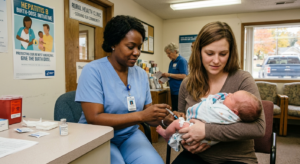
Currently, only 17% of newborns in Africa receive the critical Hepatitis B “birth-dose” vaccine—the shot given within 24 hours of birth to prevent mother-to-child transmission. In many sub-Saharan countries, the infrastructure to reach infants in that vital first day simply isn’t there. Without closing this gap, the WHO warns that we will continue to see hundreds of thousands of preventable chronic cases every decade.
“Eliminating hepatitis is not a pipedream,” stated WHO Director-General Dr. Tedros Adhanom Ghebreyesus upon the report’s release. “But the tools must reach the people. A vaccine sitting in a warehouse is not a vaccine; it is a missed opportunity.”
The Disparity in Treatment
The report also highlights a massive disconnect in treatment access. For Hepatitis C (HCV), we now have direct-acting antivirals that can cure the disease in over 95% of cases. Yet, despite the drop in drug prices, only 20% of people eligible for HCV treatment have actually received it since 2015.
For Hepatitis B, the situation is even more dire. Less than 5% of the 240 million people living with chronic HBV are currently receiving life-saving antiviral therapy. Most of these individuals live in just 10 countries, which account for nearly 70% of the global burden.
The Road to 2030: A Call for Action
The 2026 report serves as a “red alert” for the international community. To meet the 2030 elimination targets, the WHO suggests five priority actions:
Universal Birth-Dose: Rapidly scaling up the 24-hour HBV vaccine in Africa.
Decentralized Testing: Moving diagnosis from high-end hospitals to local primary care clinics.
Price Equity: Ensuring that low-income nations have access to the same cure rates as the West.
Prevention of Mother-to-Child Transmission: Providing antivirals to pregnant women to lower viral loads.
Harm Reduction: Strengthening safe injection practices to curb Hepatitis C spread among vulnerable populations.
Conclusion
The Global Hepatitis Report 2026 makes it clear: we have the science, but we lack the equity. The “lethal gap” is not a medical mystery; it is a logistical and political challenge. As the 2030 deadline looms just four years away, the debate has shifted from how to save lives to who we are willing to save. If the world can close the African birth-dose gap and modernize treatment delivery, the goal of a hepatitis-free world remains within reach. If not, the 1.3 million annual deaths will remain a tragic constant in an era of otherwise miraculous medicine.