
The $15 Billion Bet: Inside the Leaked SpaceX IPO Filing
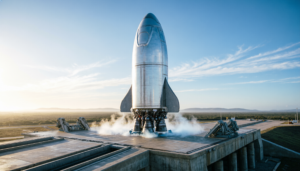
For years, Elon Musk teased that SpaceX would only go public once the “Starship” architecture was stable. In May 2026, it appears that moment has arrived. Leaked documents show that SpaceX has poured over $15 billion into the development of the world’s first fully reusable heavy-lift rocket.
The filing doesn’t just reveal a space company; it reveals a trillion-dollar infrastructure play that intends to dominate the next century of both orbital logistics and artificial intelligence.
Starship: The Backbone of the $1.75 Trillion Valuation
At a projected valuation of $1.75 trillion, SpaceX is entering the public markets as one of the most valuable entities on Earth—surpassing the market caps of traditional giants like Amazon or Alphabet. The justification for this price tag lies in Starship’s ability to shatter the “cost-per-kilogram” barrier to space.
According to the leaked data, Starship is expected to drop launch costs to under $100 per kilogram, a figure that makes traditional rocket companies look like 19th-century steam engines. This isn’t just about going to Mars; it’s about making orbit a viable neighborhood for industrial-scale commerce.
The AI Satellite Network: A 100-Gigawatt Future
The most “trending” revelation in the filing is the mention of a 100-gigawatt AI satellite network. Market analysts have long speculated how SpaceX would leverage its Starlink dominance, and the answer appears to be “Orbital Compute.”
SpaceX plans to use Starship to deploy “V3” Starlink satellites, which are significantly larger and more powerful than current models. These satellites are designed to act as a global, space-based AI mesh. By hosting massive server farms in orbit—where cooling is easier and solar energy is constant—SpaceX intends to sell AI processing power to nations and corporations, bypassing the terrestrial energy grid constraints that are currently bottlenecking AI growth on Earth.
Vertical Integration: Starlink meets Starship
The IPO documents clarify the symbiotic relationship between SpaceX’s two halves:
Starship provides the transportation: A massive cargo hold capable of carrying 100+ tons to orbit in a single flight.
Starlink provides the recurring revenue: The cash flow from the satellite internet business—now boasting over 10 million subscribers—will fund the ongoing iterations of Starship.
The filing notes that Starlink revenue surged to $25 billion in 2025, providing the “fortress balance sheet” necessary to take the company public while still pursuing high-risk exploration goals.
“SpaceX is no longer a launch company,” noted one Wall Street tech analyst. “With this IPO, they are becoming the utility company for the entire solar system. If you want to move data, energy, or matter off-planet, you have to pay the Starship toll.”
The Risks: Regulatory and Technical Hurdles
Despite the euphoria, the S-1 filing outlines significant risks. The Federal Aviation Administration (FAA) remains a primary bottleneck, with environmental concerns regarding the Starbase launch site in Texas listed as a “high-probability” risk to launch cadence. Furthermore, the sheer complexity of the “megatons of thrust” required for the Super Heavy booster means any catastrophic failure during a high-profile public era could result in extreme stock volatility.
Conclusion
The SpaceX IPO is more than a financial event; it is a declaration that the “Space Age” has transitioned into the “Orbital Economy.” With $15 billion already spent on Starship and a vision that bridges the gap between deep space and deep learning, Elon Musk is asking the public to buy into a future where the sky is no longer the limit—it’s the infrastructure.
If the IPO moves forward at the $1.75 trillion mark, SpaceX will not only be the king of the stars but also the most powerful arbiter of the AI-driven future. Investors are ready, the rocket is fueled, and the countdown to the world’s first “Galactic IPO” has officially begun.