The Silicon Valley Civil War: Musk vs. Altman Reaches a Verdict
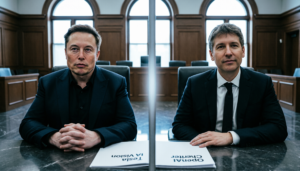
For two weeks, the eyes of the global tech community have been fixed on a San Francisco federal court. The case—Musk v. OpenAI et al.—was originally framed as a principled stance by Elon Musk to protect the “original nonprofit mission” of OpenAI. However, as Musk stepped down from the stand this week, the narrative shifted from philosophical idealism to a high-stakes corporate thriller.
The “Nonprofit” Allegation
Musk’s legal team argued that Sam Altman and Greg Brockman breached a “founding agreement” by pivoting OpenAI from a transparent, open-source nonprofit to a closed, commercial subsidiary of Microsoft. Musk testified that he donated tens of millions of dollars under the premise that the technology would be “developed for the benefit of humanity,” not for shareholder dividends.
“It was meant to be the counterweight to Google,” Musk told the court during his direct examination. “Instead, it has become a closed-source, maximum-profit-seeking black box.”
The 2025 Acquisition Bombshell
The trial’s most explosive moment came during a grueling cross-examination. Lawyers for OpenAI revealed internal 2025 communications showing that while Musk was publicly criticizing the company’s commercial turn, he was privately making an all-cash bid to acquire OpenAI’s core assets.
The revealed emails suggest that Musk proposed merging OpenAI’s intellectual property with his own AI company, xAI, to create a unified powerhouse that could rival the compute-scale of Microsoft and Google. This revelation has complicated Musk’s “humanitarian” narrative, with Altman’s defense team framing the lawsuit not as a quest for transparency, but as a “jilted founder’s attempt at a hostile takeover.”
The Bitter Rivalry of Former Allies
The testimony laid bare the personal animosity between Musk and Altman. What was once a partnership in 2015 to “save humanity from AI” has devolved into a bitter competition for dominance in the 2026 AI race.
Altman, who is expected to take the stand next week, has maintained that OpenAI’s shift to a “capped-profit” model was the only way to secure the billions of dollars in compute power necessary to achieve AGI. Musk, meanwhile, remains the primary outlier, leveraging his vast wealth and his control over the X (formerly Twitter) data stream to build a competing ecosystem.
What’s at Stake for the Industry?
The outcome of this trial will set a massive legal precedent for the AI industry:
Contractual Precedent: Can a “founding mission” be legally binding if a formal contract wasn’t signed?
AGI Definition: The court is being asked to weigh in on whether GPT-5 or its successors constitute AGI, which would trigger specific licensing changes under OpenAI’s current bylaws.
Open Source vs. Closed Source: A verdict for Musk could force OpenAI to release certain model weights, potentially shifting the balance of power back to the open-source community.
Conclusion
As the trial moves into its final phase, the tech industry is left to grapple with the reality that its two most influential figures are now sworn enemies. Regardless of the judge’s ruling, the “Musk vs. Altman” saga has permanently altered the trajectory of artificial intelligence. The trial proved that in the race for the world’s most powerful technology, the line between saving the world and owning it is razor-thin.
With the 2026 AI rally already pushing valuations to record highs, the “civil war” in Silicon Valley is just beginning. One thing is certain: the original nonprofit dream of 2015 is dead; the era of AI industrialism is here to stay.